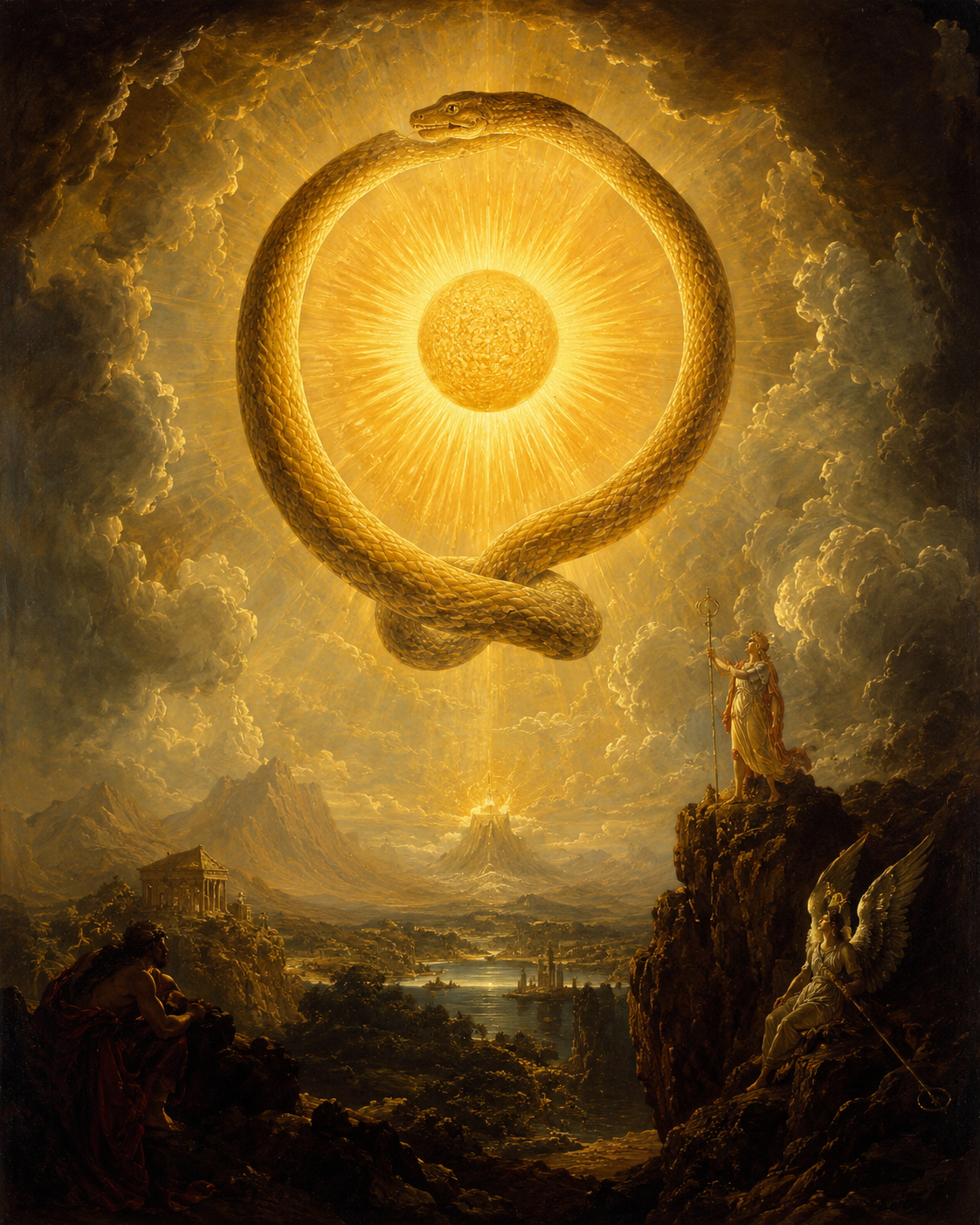
The coming of the age of Zarathustra is now upon us, as the ideas laid out by Dionysus in Thus Spoke Zarathustra has rung through humanity over the last 150 years, where we have lived through the death of God and the age of the last man.
Zarathustra predicted all, and now as the great men of the future we can appreciate the words of this renewal without the residual shock of old weary ears, desperately clinging to the God that they had killed. Dionysus is now upon us, and humanity takes a leap into a new and exciting world, ready to embark on its next great age.
Zarathustra heralded the age of a new religion, and here are its most essential tenets, as outlined in part one of Thus Spoke Zarathustra.
1. The Doctrine of the Übermensch and Will to Power
“Man is something that is to be surpassed. What have ye done to surpass man?”
The Doctrine of the Übermensch is the belief that humanity is on the pathway to God, where the highest highs and lowest lows are found, will be as tendrils throughout time that form into the Übermensch of the future. This is a process of continuous struggle of overcoming and improvement until humanity has reached God, the Holy Father.
This continuous struggle is called the Will to Power, and this confers transcendental meaning onto life, as life struggle is the bridge to God, the Übermensch.
“Man is a rope stretched between the animal and the Übermensch — a rope over an abyss. A dangerous crossing, a dangerous wayfaring, a dangerous looking-back, a dangerous trembling and halting.
What is great in man is that he is a bridge and not a goal.”
2. The Prophecy of the Transvaluation of Values and Manifest Destiny
“Innocence is the child, and of forgetfulness, a new beginning, a game, a self-rolling wheel, a first movement, a holy Yea.
Aye, for the game of creating, my brethren, there is needed a holy Yea unto life: its own will, willeth now the spirit; his own world winneth the world’s outcast.
Three metamorphoses of the spirit have I designated to you: how the spirit became a camel, the camel a lion, and the lion at last a child.”
Zarathustra prophesied that we have entered, after the age of the last man which constitutes recent history and is now ending, the age of the child. We call upon our most primal and base feelings and instincts and determine humanity’s new destiny. We call upon the twinkle in our eye and the wonder of imagination.
This destiny is the transvaluation of humanity from its current decayed form, into a Space Empire, with a manifest destiny to conquer and rule the Milky Way galaxy and eventually the universe. Humanity must leave Earth and the last man behind and embark on its greatest adventure yet, the colonization of the stars.
“It is time for man to fix his goal. It is time for man to plant the germ of his highest hope.
Still is his soil rich enough for it. But that soil will one day be poor and exhausted, and no lofty tree will any longer be able to grow thereon.
Alas! there cometh the time when man will no longer launch the arrow of his longing beyond man — and the string of his bow will have unlearned to whizz!
I tell you: one must still have chaos in one, to give birth to a dancing star. I tell you: ye have still chaos in you.
Alas! There cometh the time when man will no longer give birth to any star. Alas! There cometh the time of the most despicable man, who can no longer despise himself.
Lo! I show you the last man. “What is love? What is creation? What is longing? What is a star?” — so asketh the last man and blinketh.
The earth hath then become small, and on it there hoppeth the last man who maketh everything small. His species is in-eradicable like that of the ground-flea; the last man liveth longest.”
3. The Doctrine of a Thousand Gods
“table of excellencies hangeth over every people. Lo! it is the table of their triumphs; lo! it is the voice of their Will to Power.
It is laudable, what they think hard; what is indispensable and hard they call good; and what relieveth in the direst distress, the unique and hardest of all, — they extol as holy.
Whatever maketh them rule and conquer and shine, to the dismay and envy of their neighbours, they regard as the high and foremost thing, the test and the meaning of all else.”
The Doctrine of a Thousand Gods is Zarathustra’s proclamation that every people have a spirit, every people have a God or Gods, this being what makes them rule and conquer and shine above and in conflict with others. This spirit is their foremost priority and test as a people. It is the spirit and destiny of their people, and in a people’s spirit lies the path to the higher man.
As well as being their primary test, it is also an obligation to their ancestors, an inter generational mastery that is built through the loyalty of each generation to those who came before. The spirits of a people are the unique values and essence that they have created and embodied which lives with them in their blood, all elements to be mastered and that will ultimately become the higher man.
The spirits of a people are created by them, and if the day comes, die with them. The Will to Power and struggle for continuation is the duty of a people to their ancestors.
“To honour father and mother, and from the root of the soul to do their will” — this table of surmounting hung another people over them, and became powerful and permanent thereby.
“To have fidelity, and for the sake of fidelity to risk honour and blood, even in evil and dangerous courses” — teaching it self so, another people mastered itself, and thus mastering itself, became pregnant and heavy with great hopes.
Verily, men have given unto themselves all their good and bad. Verily, they took it not, they found it not, it came not unto them as a voice from heaven.
Values did man only assign to things in order to maintain himself — he created only the significance of things, a human significance! Therefore, calleth he himself “man,” that is, the valuator.
Valuing is creating: hear it, ye creating ones! Valuation itself is the treasure and jewel of the valued things.
Through valuation only is there value; and without valuation the nut of existence would be hollow. Hear it, ye creating ones!”
The Doctrine of a Thousand Gods ties into the The Prophecy of Manifest Destiny. All Gods must be fettered under the hand of Humanity’s manifest destiny amongst the stars, and humanity has in fact not become humanity until such a spirit has come forth to define humanity itself. Humanity is born when the Thousand Gods unite, distinct but fettered together and banners raised under the holy crusade for the stars.
“A thousand goals have there been hitherto, for a thousand peoples have there been. Only the fetter for the thousand necks is still lacking; there is lacking the one goal. As yet humanity hath not a goal.
But pray tell me, my brethren, if the goal of humanity be still lacking, is there not also still lacking — humanity itself? —”
4. The Doctrine of Ahura Mazda
“His disciples, however, presented him at his departure with a staff, on the golden handle of which a serpent twined round the sun. Zarathustra rejoiced on account of the staff, and supported himself thereon; then spake he thus to his disciples:
Tell me, pray: how came gold to the highest value? Because it is uncommon, and unprofiting, and beaming, and soft in lustre; it always bestoweth itself.
Only as image of the highest virtue came gold to the highest value. Goldlike, beameth the glance of the bestower. Gold-lustre maketh peace between moon and sun.”
The Doctrine of Ahura Mazda is an understanding that Zarathustra himself, or just as well Nietzsche the Avatar of Dionysus, is simply the God of Chaos and Renewal. Dionysus himself defers to the highest God, the ancient and eternal Ahura Mazda, representing the eternal force of the Sun and fire and growth and entropy. The Solar itself, locked in eternal battle against the force of darkness.
Zarathustra does not surpass God, but simply swipes away the old serpent which had grown fat and eaten its own tail, and replaced it with a new serpent. Zarathustra’s serpent is the new wise interpreter of the sun which it coils itself around.
“Power is it, this new virtue; a ruling thought is it, and around it a subtle soul: a golden sun, with the serpent of knowledge around it.”