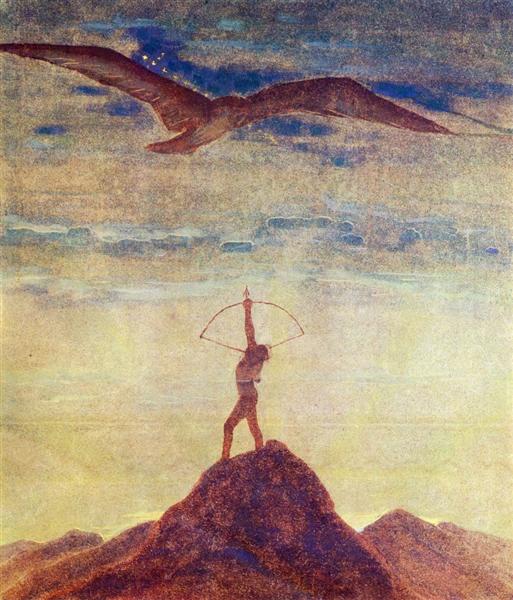
The modern day pagan revival draws on deep spiritual currents within the Hyperborean man. He feels out of tune with the erstwhile religion of his people, Christianity, and eschews its desert prophets. He views his own traditions, his own magic, his own essence, as above all.
But in his newfound faith in his ancestors and his attempts to rekindle it he discovers an apparent contradiction. If the Old Gods were so great, and were champions for all that was good, then why did they die?
Nietzsche, as the avatar of Dionysus answers this question in Thus Spoke Zarathustra.
“Behold, here is a new table; but where are my brethren who will carry it with me to the valley and into hearts of flesh? —Thus demandeth my great love to the remotest ones: be not considerate of thy neighbour! Man is something that must be surpassed.
There are many divers ways and modes of surpassing: see thou thereto! But only a buffoon thinketh: “man can also be overleapt.” Surpass thyself even in thy neighbour: and a right which thou canst seize upon, shalt thou not allow to be given thee!
What thou doest can no one do to thee again. Lo, there is no requital. He who cannot command himself shall obey. And many a one can command himself, but still sorely lacketh self-obedience!”
The Pagans allowed the preachers of death into their lands. They were considerate of their neighbours and their distinct Gods, and much of the time allowed their neighbours to be conquered by sustained Christian assault, either in allowed missionary activity or by the sword.
Man cannot be overleapt, and he who cannot command himself shall obey! Was the preaching of death not a cosmic irony to the allowers of death? As Nietzsche says, Jesus Christ was the superman, what he calls “The only Christian”, and this is an acknowledgement that the core aim of this epoch in humanity was to unlock the core flaw in Paganism. The pacifistic libertarianism, the sinking of the aristocracy into the mass, the guilt and pity, the refusal to exert a religious will.
These are the sins of Paganism, and if the modern man cannot learn from the mistakes of his ancestors, and instead wish to repeat them without the benefit of isolation, then crushing divided Paganism will be a simple matter for the unified preachers of death.
Dionysus lays out in Ecce Homo what has been learnt from this era of history, and what will become as a result:
“Let us look a century ahead, and let us suppose that my attempt to destroy two millenniums of hostility to Nature and of the violation of humanity be crowned with success That new party of life-advocates, which will undertake the greatest of all tasks, the elevation and perfection of mankind, as well as the relentless destruction of all degenerate and parasitical elements, will make that superabundance of life on earth once more possible, out of which the Dionysian state will perforce arise again.
I promise the advent of a tragic age : the highest art in the saying of yea to life, “tragedy,” will be born again when mankind has the knowledge of the hardest, but most necessary of wars, behind it, Everything in this essay is a prophecy:
The proximity of the resurrection of the Greek spirit, the need of men who will be counter-Alexanders, who will once more tie the Gordian knot of Greek culture, after it has been cut.”
Thus Dionysus has explicitly called out to you Pagans, to seek out a new Dionysian spring, and establish a new Dionysian state what. All Gods are but elements in the great universal God, the universal life force which seeks out the elevation and perfection of mankind.
Do not make the mistake of taking from your ancestor only what he had as he was cut down. Take what he had when he was riding high with vitality and strength. Learn from the youthful culture, and unite yourselves with the wisdom of Dionysus and his Prophet of Zarathustra.
The job is to overcome and become and create, and that is what shall be done.